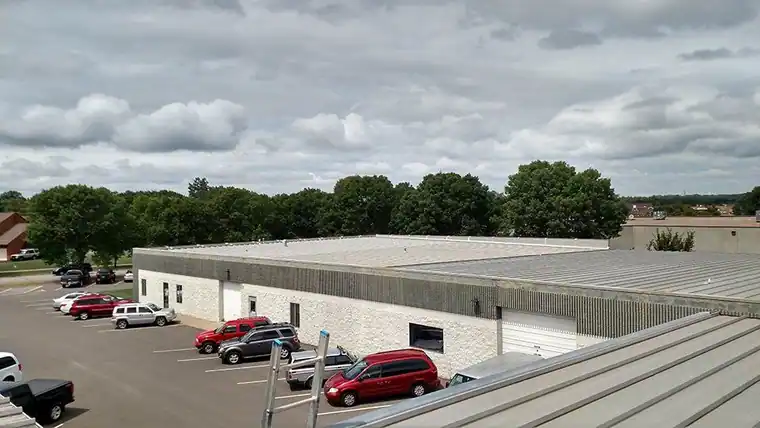
Where low-slope roofs fail first: seams, flashings and standing water
Most commercial leaks do not start in the middle of a field of membrane. They start where the roof is interrupted: a seam that was never fully welded, a base flashing that has pulled away from a parapet wall, a pipe boot or curb that moved with the building while the sealant around it could not follow. We trace the water to its entry point before we quote anything, because a patch placed over the ceiling stain is usually a patch in the wrong place.
Ponding is the second pattern. A low-slope roof that still holds water a day after the sun comes out is aging faster than the rest of the building, and the membrane, the seams and the insulation beneath all pay for it. Sometimes the fix is tapered insulation and added drains during a replacement. Sometimes it is a scupper that a season of leaves has closed. We read the deck, the drainage path and the edge metal together, not the membrane alone.
Each system announces its age differently. Built-up and modified bitumen roofs show alligatored surfacing, blisters that have opened and felts exposed at the laps. Single-ply roofs show shrunken membrane at corners and seams that have started to lift. Knowing which system you are standing on tells us what failed and what can still be saved.
A free inspection, a same business day reply, and a system chosen for the building
Call or email and you hear back the same business day. The free commercial roof inspection that follows is a walk of the whole roof: deck edges, drains, penetrations and rooftop equipment, with notes and photographs of what we find. You get a plain read on whether the roof needs repair, maintenance or replacement, and nothing to sign to get it.
System choice comes from the building, not from a favourite product. GAF RhinoBond TPO is induction-welded: plates are fastened to the deck under the insulation, and the membrane is bonded to them from above without fasteners punched through the sheet. Standard TPO and PVC single-ply are heat-welded at the seams, and PVC earns its place over restaurant exhaust and other grease and chemical exposure. Fully adhered EPDM is a quiet, proven membrane when the substrate suits it. Hot asphalt built-up and modified bitumen are multi-ply systems with a long record on busy roofs that see foot traffic.
Steep slope and standing seam metal sit alongside the low-slope systems, and architectural sheet metal ties them together: copings, edge metal, gutters, scuppers and counterflashing. Crews work to OSHA site safety practice, with fall protection in place before anyone walks the roof, under Minnesota Building Contractor License BC320318 with liability and workers' compensation insurance.
Maintenance, reflective coatings and an honest repair-or-replace evaluation
A roof on a Little Canada warehouse or a St Paul office building will outlast its neighbours if somebody walks it twice a year. Maintenance means clearing drains, re-sealing flashings, checking seams and penetrations, and fixing small things while they are small. We treat roof repairs and maintenance as a regular service, not only the emergency call.
Reflective roof coatings can extend the life of a sound roof and cut heat gain, and they suit buildings working toward LEED goals. A coating is not a rescue for wet insulation, so we confirm what is under the membrane before we recommend one.
When the evaluation says replace, we tell you why, show you the areas that drove the decision and lay out the system options. When it says repair, we say that too. The aim is a roof you stop thinking about, from a contractor who answers the phone the next time you do need one.