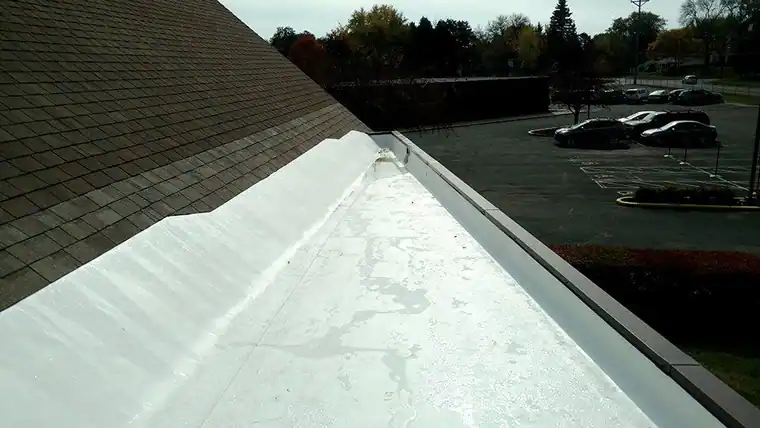
Membrane splits, ponding and blistered built-up: how flat roofs fail
No flat roof is truly flat, and the ones that fail are usually the ones that forgot it. Ponding water is the common thread. Standing water softens surfacing, works at every seam and adds weight to a deck that was never meant to carry it, and it tends to sit in the same low spot year after year. Before we repair anything we check where the water goes, because a new membrane over a low spot just repeats the problem.
Membrane splits are a symptom of movement. A single-ply roof opens along an insulation board joint, at a change in the deck or where the membrane was stretched tight around a curb, and the building keeps moving after the patch is down. A repair that seals the crack without asking why it opened will be back on the schedule within a season or two.
Built-up roofs fail by blistering: moisture or air trapped between plies lifts the surface, the blister cracks, and the felts underneath are left exposed to sun and water. Parapets add their own failure point. Water gets behind a coping cap when its joints open, then runs down the wall behind the base flashing. The fix is in the detail, not in a bead of caulk.
Installing, repairing and replacing across TPO, EPDM, modified bitumen and built-up
A good flat roof is built from the deck up. We confirm the substrate is sound and dry, set insulation with tapered sections where drainage needs help, and add a cover board where the system calls for one. Then the membrane goes down: heat-welded TPO, fully adhered EPDM, torch or cold-applied modified bitumen, or hot asphalt built-up plies. Each has a place, and we pick by the building, its traffic and what sits on the roof.
Repair versus replace is a call we make with evidence. We check for wet insulation, trace the open seams and flashings, and tell you how much of the roof is still doing its job. A partial repair makes sense on a roof that is sound apart from one failed section. A recover or full tear-off makes sense when the insulation has taken on water and is no longer worth protecting.
Edges finish the roof. Parapet walls get base flashing carried up and terminated under counterflashing, and coping caps are fitted with sealed, fastened joints so they shed water off the wall rather than into it. Our architectural sheet metal work handles copings, gutters, scuppers and drip edge on a Little Canada warehouse or a St Paul office building alike.
Inspection cadence and coatings that keep a flat roof working
Flat roofs repay attention. We suggest a walk in spring and again in fall, plus a look after any serious storm, to clear drains, check seams and flashings, and catch punctures from other trades who have been on the roof. Small repairs found early cost far less than the ones found through a ceiling tile.
On a sound membrane, a reflective coating can add service life and lower heat gain. We only recommend one after we have checked the insulation beneath it, since coating over wet material seals the problem in.
Every job ends with a clean site and a follow-up. The work is done under Minnesota Building Contractor License BC320318, with OSHA site safety observed from the first day on the roof.