TPO, EPDM, PVC or Built-Up: Choosing a Commercial Flat Roof
Those letters are families of roofing systems, and each one suits some buildings better than others.
October 14, 2026 · 4 min read
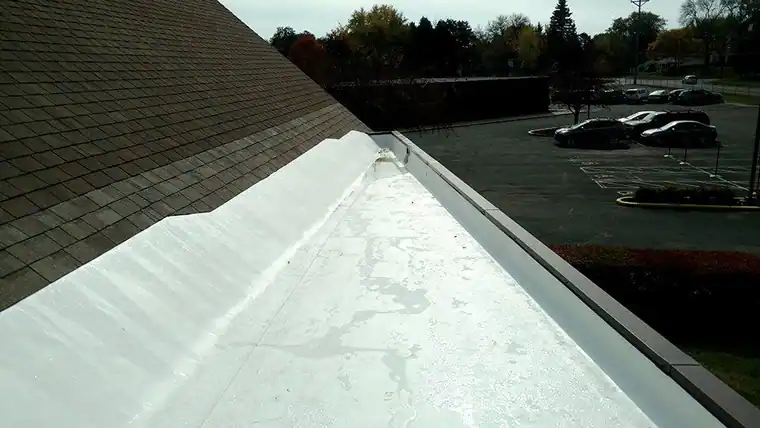
If you manage a warehouse, a strip of shops, an apartment building or a church hall with a low-slope roof, you have probably heard roofers toss out a string of letters: TPO, EPDM, PVC, mod-bit, BUR. They aren't brand names. They are families of roofing systems, and each fits some buildings better than others. Here is a plain guide to what they are and how to choose.
A flat roof is never really flat
Almost every so-called flat roof is built with a slight slope toward drains, scuppers or gutters. Water that sits for days is the enemy. It finds weak seams, adds weight, and breeds algae that wears on the surface. When you compare systems, drainage is the first thing to look at. Tapered insulation, new drains or a corrected slope can matter as much as the membrane you put on top.
Single-ply: TPO, PVC and EPDM
TPO is a white, reflective sheet whose seams are welded with hot air, so the seam becomes part of the membrane instead of a glued joint. Austad installs GAF RhinoBond TPO, which uses induction welding. Plates are fastened through the insulation into the deck, and the membrane is then bonded to those plates with an induction tool, which keeps fasteners from punching through the membrane itself. The white surface also reflects heat, which helps with summer cooling.
PVC is welded at the seams as well and is known for standing up to grease, oils and chemicals. That makes it a common choice over restaurants and any building whose exhaust leaves residue on the roof.
EPDM is a rubber membrane, usually black, with a long record in cold climates. Austad installs fully adhered EPDM, where the sheet is bonded to the surface beneath it across its whole area instead of being held down by ballast or scattered fasteners. Its seams are joined with adhesive or tape rather than welded, so seam workmanship is the thing to ask about.
Layered systems: built-up and modified bitumen
Built-up roofing, usually called BUR, is the old workhorse: layers of reinforcing felt laid in hot asphalt and finished with gravel or a coating. Modified bitumen comes in rolls of polymer-modified asphalt and is also laid in layers, then heat-welded, mopped or self-adhered depending on the product. Both give you redundancy, since several layers sit between the weather and the deck, and both tolerate foot traffic from service techs well.
The tradeoffs are weight and installation. Hot asphalt and open flame call for tight safety practice, and tenants may notice odor during the work. Austad installs hot asphalt built-up and modified bitumen, and works to OSHA safety standards, which is one of the things to confirm with any contractor who will be doing hot work above your people.
Matching the system to your building
There is no single winner. Work through these points with whoever is walking your roof.
- How much foot traffic will the roof see from service techs and rooftop units?
- What sits on the roof: grease exhaust, chemicals, heavy equipment?
- What is the existing roof, and can it stay under the new one?
- Where does the water go, and does the slope need correcting?
- How long will you own the building, and who answers the call when it leaks?
- Does the installer carry the manufacturer's certification behind the warranty?
That last point matters more than it sounds. A manufacturer's warranty is only as useful as the installer behind it. Austad is certified with Carlisle, Firestone, Boral and Fabral, and carries the GAF Master Select designation, and extended warranties are available. Ask any contractor you consider to show the certification, not just mention it.
Repair, coat or replace
Not every aging commercial roof needs a tear-off. Austad handles roof repairs, maintenance, coatings and evaluations as well as full replacement, and the evaluation comes first: a walk of the roof, a look at seams, flashings and drains, and a check on the condition of the insulation underneath. A reflective coating over a sound membrane can extend its working life. Over wet insulation it only hides a problem. That is why an honest evaluation matters more than the name of the system.
Start with a free inspection
Austad offers free commercial roof inspections and answers calls and emails the same business day, which helps when water is dripping onto inventory or a sanctuary floor. Property managers and church facilities committees can carry the findings back to a board or an owner and ask for estimates on more than one system. Call (651) 482-0070 and say what the building is and what the roof is doing. Austad works across the Twin Cities from its shop in Little Canada.
Austad Construction, (651) 482-0070
Call (651) 482-0070More articles
What to Check on Your Roof After a Twin Cities Hail Storm
Hail marks everything it touches, and you can read most of it without ever climbing a ladder.
Standing Seam Metal or Class 4 Shingles for a Minnesota Home?
Both roofs are built for hail and hard winters, and they go about it in very different ways.