Re-Roofing a 100-Year-Old House or Church: What Changes
A hundred-year-old roof is a different job, and the differences start under the shingles.
October 14, 2026 · 4 min read
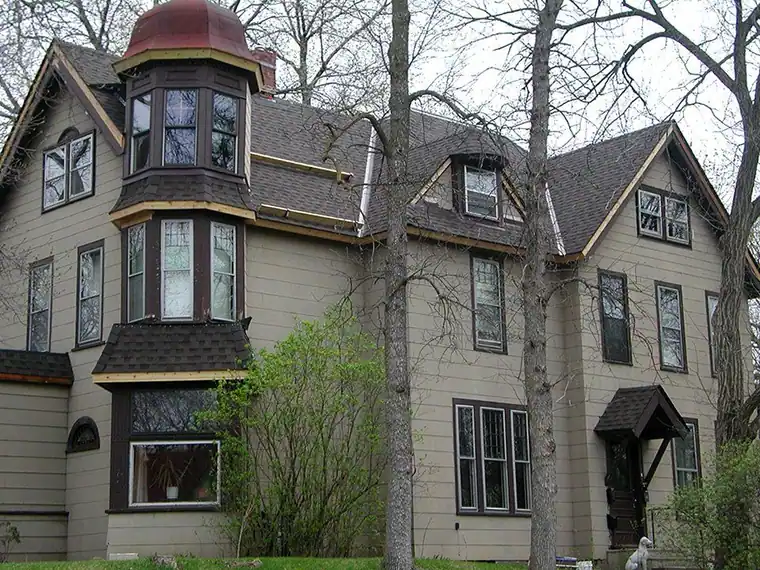
A roof on a hundred-year-old house or church is a different job from a roof on a house built in 1995. The shape is more complicated, the framing is older, and the metalwork is often hand-formed. None of that is a reason to put the work off. It is a reason to hire someone who has done it before and to know what you are asking for.
Start with what is under the old roof
Older buildings are usually decked with wide boards, spaced or tight, rather than sheets of plywood. Board decking can be very good, but it also shifts, shrinks and sometimes rots where a gutter or a chimney has leaked for years. Once the old roofing is off, the deck has to be inspected and repaired before anything new goes on. That is why a careful estimate on an old building says plainly how decking repairs will be handled instead of promising a final figure before anyone has seen the wood.
Many old roofs also carry more than one layer of roofing, with the history of every previous repair buried underneath. Tearing down to the deck lets a crew see the true condition of the structure, which is worth far more than the shortcut of covering over a problem.
Turrets, bays and valleys
Queen Anne houses and Victorian homes in St. Paul and Minneapolis are full of turrets, dormers, bays and intersecting gables. Every one of those is a valley, a hip or a wall junction, and every junction is a place for water to get in if the flashing is wrong. A conical turret cannot be roofed like a plain slope. Each course has to be cut and fitted to a curve that keeps getting tighter toward the point. Doing that well is slow work, and a crew that rushes it leaves a roof that looks wavy and leaks at the seams.
Bell towers, steeples and architectural sheet metal
Churches add another layer. Bell towers, steeples, cornices and box gutters are made of sheet metal worked by hand, and they depend on flashings that are folded, soldered or locked into place to shed water. That is architectural sheet metal, and it is a different trade from nailing shingles. Austad does architectural sheet metal along with historic preservation and restoration work on churches.
First Congressional Church on 3rd Avenue in Anoka had hail damage in 2006 and bell tower work in 2007. In a letter about that work, the church wrote that Austad was by far the most knowledgeable of the contractors it talked to, and that no fewer than three other companies had tried to fix its roof leaks and failed. Old churches are where leaks hide in odd corners, and that story is the reason to ask any contractor what they have actually repaired on a building like yours.
Matching the look without faking the history
Restoration doesn't mean copying an old roof exactly. It means choosing materials, profiles and colors that suit the building. Heavier dimensional shingles can recall the texture of older roofing, and a standing seam or a formed metal panel can be right where the original was metal. If your property sits in a historic district, ask the city's preservation office what rules apply before you sign anything, and ask your contractor to confirm that the product on the estimate will be accepted.
What to ask for in an old-roof estimate
- How the contractor will inspect and repair the roof deck once the old roofing is off
- How chimneys, valleys, turrets and wall junctions will be flashed
- What material and profile will cover each section of the roof
- How the interior, the organ or the finished plaster will be protected during tear-off
- How the crew will work around services, weddings and neighbors
- What the cleanup plan is for the yard, the gardens and the gutters
Working around a congregation or a family
On an occupied building the schedule matters as much as the shingles. A church has services and funerals, and a family home has children and pets. A crew that plans around the people inside shows its quality long before the roof is finished. The customers who write about Austad mention it often. One homeowner said neighbors were amazed at how clean the yard was and that no plants were damaged, and another was impressed with how clean the crew left the gardens.
Austad Construction has been in business since 1997, is family-owned, and is licensed in Minnesota under BC320318. Roof evaluations for churches are free, and so are estimates for homes. Call (651) 482-0070 and ask to have someone look at the roof, the tower and the metalwork together.
Austad Construction, (651) 482-0070
Call (651) 482-0070More articles
What to Check on Your Roof After a Twin Cities Hail Storm
Hail marks everything it touches, and you can read most of it without ever climbing a ladder.
Standing Seam Metal or Class 4 Shingles for a Minnesota Home?
Both roofs are built for hail and hard winters, and they go about it in very different ways.